 Prakhar Gautam
TSMC's newest thermal packaging work etches microfluidic channels straight into copper pillars bonded to the chip's backside, running deionized water through the package itself instead of across a paste joint sitting above it. That's the endpoint. The version actually shipping first is a microchannel lid: a metal cap with etched channels bonded on top of the die, water flowing through the cap, one thermal interface material layer still sitting between silicon and lid. Both are working around the same problem. At the power densities modern accelerators are pulling, the paste is no longer a minor loss term. It is the bottleneck.
Some numbers to make that concrete: high-end GPU packages are already sitting near 1,800 watts, with the generation after that projected higher still. A 1,800-watt die pushing that much flux through a square centimeter or two of silicon doesn't leave much margin for a material sitting in the thermal path whose entire job is to not be there.
Grease was never going to survive this
Standard thermal grease is a silicone or hydrocarbon oil loaded with a conductive filler — usually a metal oxide or nitride powder — and it does two jobs: fill the microscopic gaps between two surfaces that only look flat, and conduct heat across that gap better than the air it displaced would. Typical thermal conductivity for a good commercial grease runs somewhere in the single digits of W/m·K. That was fine when packages were pulling a few hundred watts. It stops being fine once you're past a kilowatt through a die the size of a postage stamp.
Grease also degrades in a specific, well-studied way that has nothing to do with its conductivity number on a datasheet. Every power cycle flexes the assembly slightly, because the chip package and the heatsink expand and contract at different rates as they heat and cool — a coefficient of thermal expansion mismatch. That flexing squeezes the grease out sideways a little more each cycle, a failure mode called pump-out. Thousands of cycles later, there's a dry patch exactly where the hottest part of the die sits, and the chip's effective thermal resistance has quietly climbed without anyone changing a single setting.
Liquid metal is the obvious upgrade, with a catch
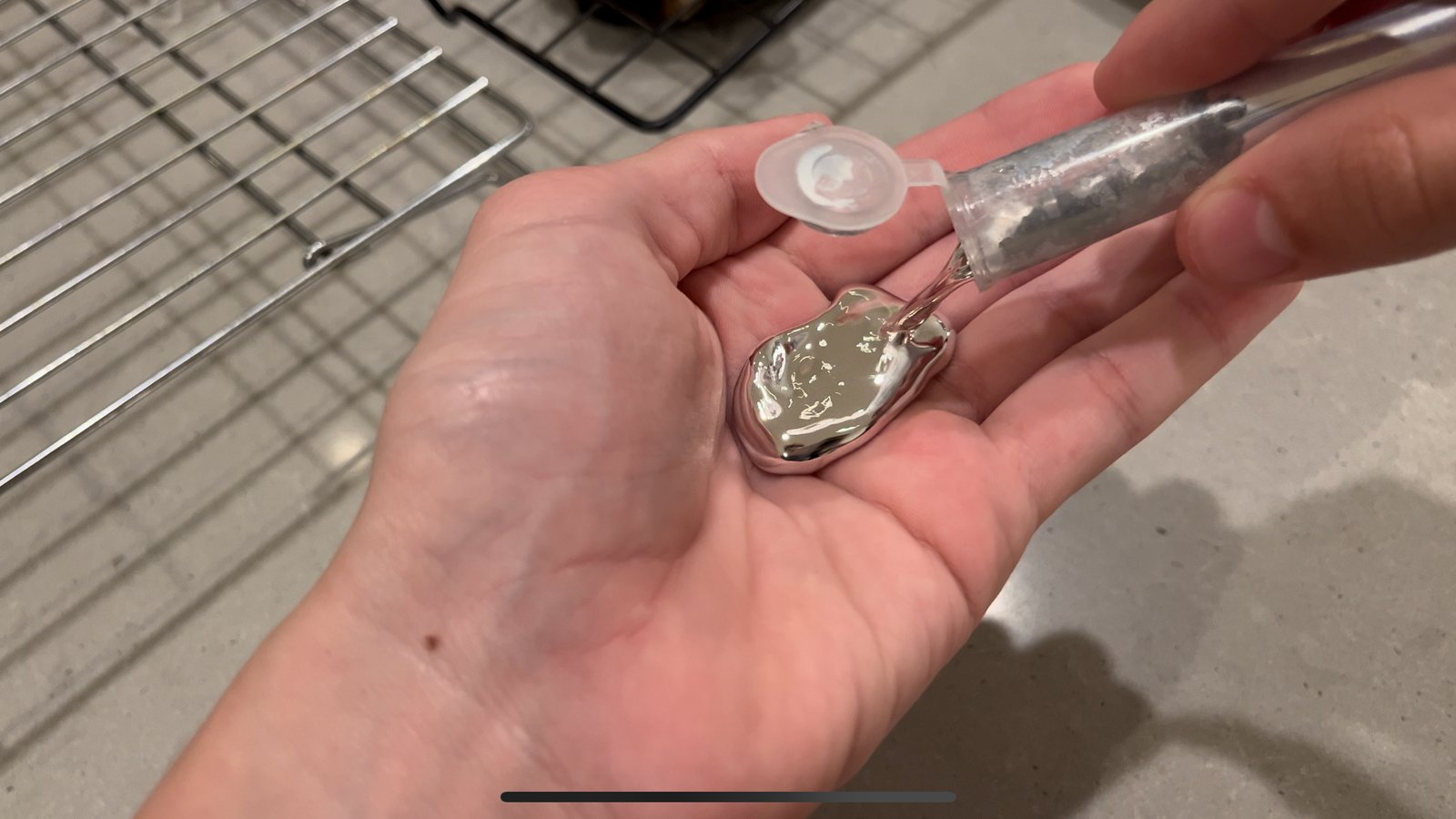
Gallium showed up on this site a few weeks ago as the wide-bandgap semiconductor that shrank your phone charger. Here it's doing a completely different job, not as a solid nitride switching current but as a liquid metal moving heat. Gallium and its eutectic alloys with indium and tin — EGaIn, Galinstan — stay liquid at or near room temperature and carry heat the way a metal does, because it still has a metallic bond and free electrons even in the liquid state. That gets you thermal conductivity in the tens of W/m·K, roughly an order of magnitude past silicone grease, with none of the pump-out problem, since a liquid metal that gets squeezed sideways during thermal cycling just flows back when the gap reopens.
The catch is that gallium is genuinely hostile to aluminum. Bring liquid gallium into contact with bare aluminum and it wets the surface and diffuses straight down the grain boundaries, a process called liquid metal embrittlement. The aluminum doesn't corrode away visibly the way rusting steel does — it goes chalky and structurally weak from the inside, and enough gallium migration can leave a piece of aluminum that looks intact crumble under light pressure. PC enthusiasts who've used a liquid-metal TIM near an aluminum heatsink or backplate already know this by the white, crusty damage that shows up days or weeks later, not immediately.
That single incompatibility is why liquid metal TIMs mean redesigning the whole thermal stack, not just swapping a paste. Every surface the liquid metal can reach — heat spreader, cold plate body, mounting hardware — has to be nickel-plated copper or otherwise barrier-coated, because aluminum in the assembly is no longer an option. Datacenter packages built around liquid metal TIMs are, quietly, also committing to nickel-plated copper everywhere the metal can wander.
Where the spreading actually happens: diamond and SiC
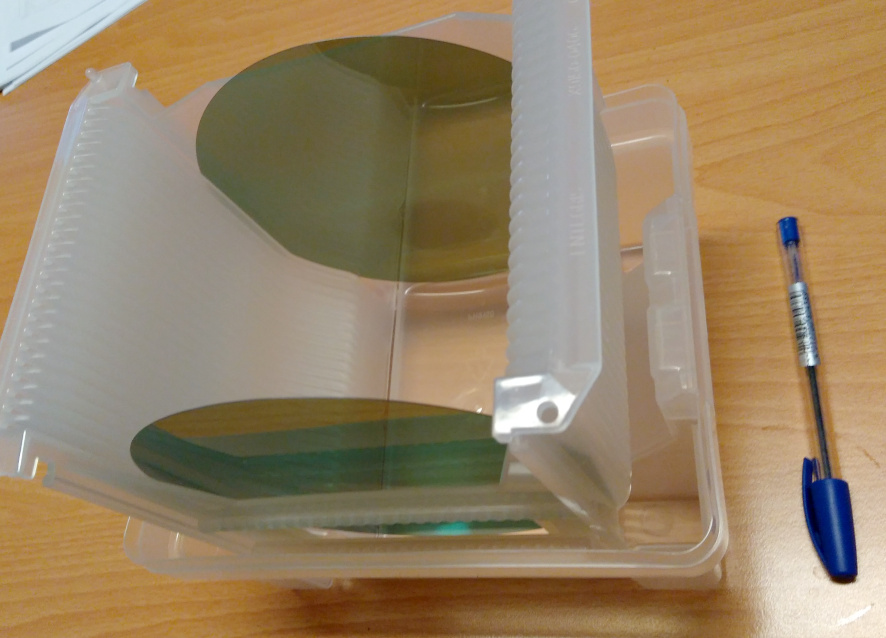
A TIM's job is to bridge a gap. A heat spreader's job is different — take the intense, concentrated flux coming off a hotspot on the die and spread it laterally before handing it to the cold plate, so the cooling loop is pulling from a wide area instead of a point. Copper does this reasonably well, at roughly 400 W/m·K. Silicon carbide sits in almost the same conductivity range, which surprises people who expect it to be the upgrade — its real advantage in GaN packages isn't conductivity, it's a thermal expansion coefficient close enough to GaN's that a bonded GaN-on-SiC interface survives repeated heating and cooling without delaminating.
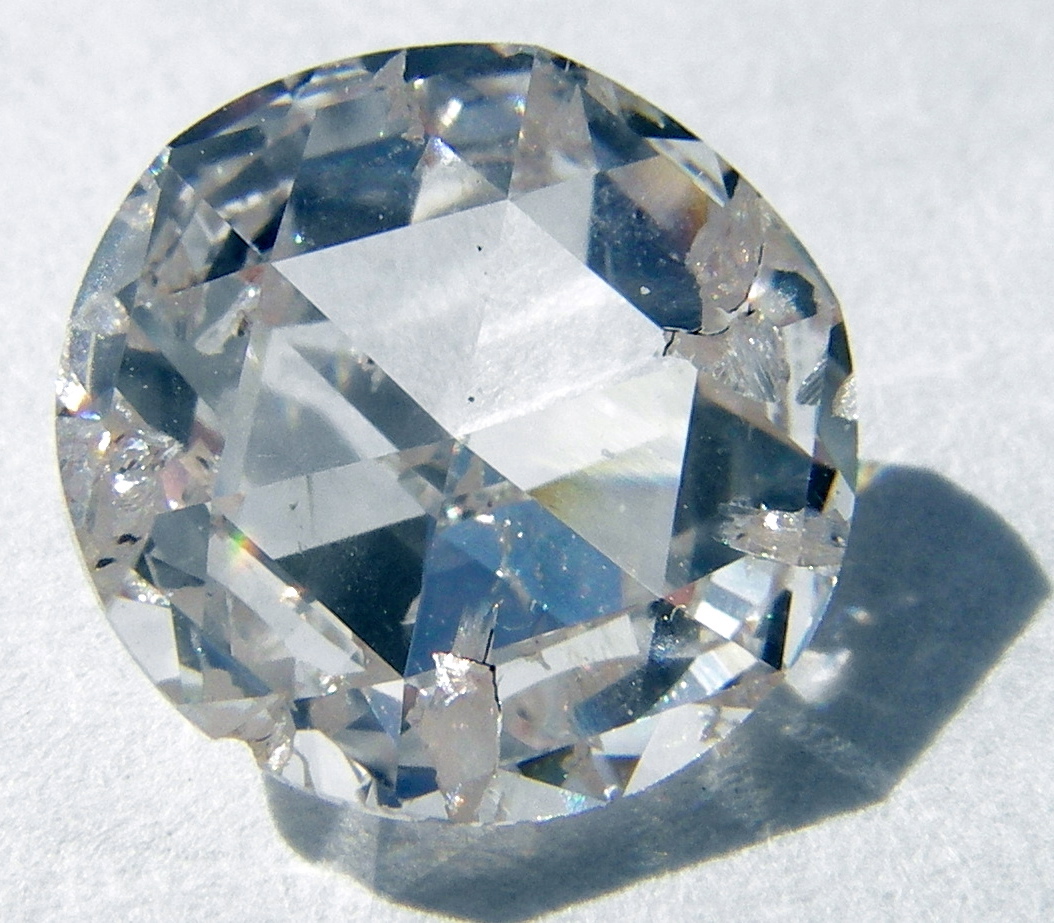
Diamond is the actual upgrade, and it isn't close. CVD polycrystalline diamond runs close to 2,000 W/m·K, single crystal higher still, roughly five times copper. GaN grown directly on a diamond substrate reaches meaningfully higher power density before it hits its thermal ceiling than the same device on SiC or silicon. What keeps diamond a specialty material rather than the default is the bonding step: getting a low-resistance thermal interface between GaN and diamond without an amorphous layer between them, and diamond wafers, is still an unsolved manufacturing and cost problem, not a physics one.
Diamond even complicates the liquid metal story. A recent materials study tracking EGaInSn against diamond over extended exposure found measurable corrosion at that interface too, which matters for anyone hoping to pair the best heat spreader with the best TIM and call the problem solved.
Two liquids get conflated constantly in this conversation and they are not the same thing. A liquid metal TIM lives inside the package, in a gap measured in microns, doing the same job paste does. The coolant in a liquid-cooled rack lives outside the package, running through millimeter-scale channels in a cold plate, doing the job air used to do. One is a metal. The other is usually water with additives. Solving a problem with one tells you almost nothing about the other.
TSMC's answer: stop asking the interface to do the job
TSMC's Si-Integrated Micro Cooler is the logical end state of all of the above: fuse a microchannel structure directly to the chip's backside and route coolant through it, removing a TIM layer from that path entirely. Their published pillar-array microchannel design, tested with deionized water on a CoWoS-packaged logic chip, hit a junction-to-ambient thermal resistance around 0.055°C/W, sustaining more than 2.6 kW of die power with under 63°C of temperature rise — about 15% better than a lidded liquid-cooled design that still has a TIM between silicon and lid.
That lidded version, with the microchannels milled or etched into a metal cap bonded over the die rather than the silicon itself, is the interim step, and it's the one closer to actually shipping — it slots into existing packaging flows, whereas bonding microchannels directly onto production silicon at yield is still being worked out. Either way, notice what both approaches are actually optimizing around: not a better TIM, but fewer TIM layers standing between the transistors and the coolant.
The other liquid: what's actually in the loop
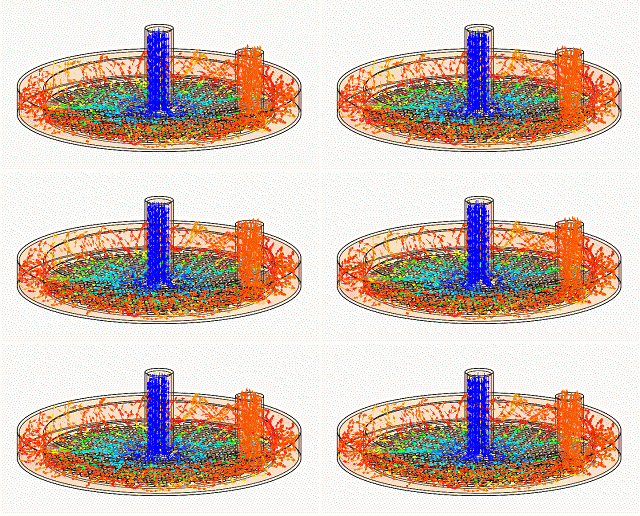
Once heat clears the package, it's the cold plate's problem, and the cold plate's problem is coolant chemistry. NVIDIA's rack-scale liquid cooling architecture is built around accepting facility water as warm as 45°C, an ASHRAE W45 classification, specifically so datacenters can run dry coolers and cooling towers instead of mechanical chillers. It's a real efficiency win at the facility level. It's also, from a materials standpoint, choosing to run the entire coolant loop hotter than it used to run, which accelerates every degradation mechanism below.
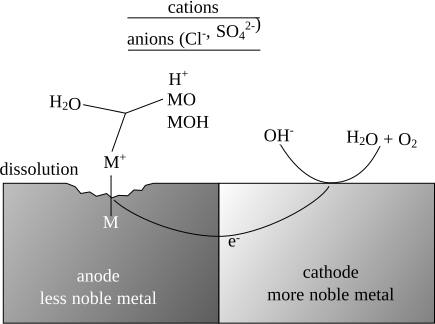
Cold plates are almost always copper, for the same conductivity reason a heat spreader would be, and they connect to manifolds and fittings that are sometimes aluminum for weight and cost. Put two dissimilar metals in electrical contact through an electrolyte — and coolant, especially as it ages and accumulates dissolved ions, is an electrolyte — and you have a galvanic cell. The less noble metal in that couple, aluminum, becomes the anode and corrodes preferentially, exactly the geometry you'd expect from a first-semester electrochemistry problem, except it's eating through a manifold instead of a battery casing.
Then there's the coolant itself. Water alone in a multi-metal loop invites its own corrosion, so most systems run a glycol-water mixture, chosen partly for freeze protection and partly for its heat capacity. Glycol doesn't sit there inertly: heat, dissolved oxygen, and the copper and aluminum surfaces it's supposed to be protecting all catalyze its breakdown into organic acids — glycolic, formic, and oxalic acid among them for ethylene glycol, mostly lactic acid for propylene glycol. A recent electrochemical study found copper accelerating that breakdown enough to drop coolant pH by roughly two full units, which then attacks the copper harder, a feedback loop that gets worse the longer a loop runs without service. The fix is the same one automotive coolant has used for decades — triazole-class corrosion inhibitors, mainly tolyltriazole and benzotriazole, that specifically passivate copper surfaces — but a rack-scale system now needs the coolant chemistry actively monitored and refreshed the same way you'd track anything else with a service life.
What I'd watch
Whether liquid metal TIMs actually make it into mainstream server packages, given that adopting one means committing to nickel-plated copper everywhere in the thermal path — that's a real bill of materials and manufacturing change, not a drop-in swap. Whether TSMC's direct-silicon microchannel integration reaches production yield before the next jump in rack power arrives, since 600-kilowatt racks are already on the roadmap for 2027 and a lidded interim design may not have the headroom to get there. And, less glamorously, whether coolant chemistry monitoring becomes a standard line item in datacenter operations the way it already is in automotive and industrial cooling, because a loop full of corrosion inhibitor decaying quietly six months into service is not a hypothetical failure mode, it's the default outcome of doing nothing.
None of this is really a silicon problem. It's corrosion chemistry and materials science wearing a semiconductor industry's clothes, which is probably why it's the part that never makes it into the slide with the transistor count on it.
Further reading
- Ji, Y., Yan, H., Xiao, X., Xu, J., Li, Y., & Chang, C. "Excellent thermal performance of gallium-based liquid metal alloy as thermal interface material between aluminum substrates." Applied Thermal Engineering, 166, 114649 (2020). DOI: 10.1016/j.applthermaleng.2019.114649
- Handschuh-Wang, S., Wang, T., Zhang, Z., Liu, F., Han, P., & Liu, X. "Long-Term Corrosion of Eutectic Gallium, Indium, and Tin (EGaInSn) Interfacing with Diamond." Materials, 17(11), 2683 (2024). Open access, CC BY. DOI: 10.3390/ma17112683
- Söhl, S. & Eisele, R. "Impact of the Pump-Out-Effect on the thermal long-term behaviour of power electronic modules." Microelectronics Reliability (2019). sciencedirect.com
- Boonen, L., Choukroun, D., Napal Azcona, I., Nappini, S., Magnano, E., Cornelus, J., & Breugelmans, T. "Corrosion inhibition of copper in glycol-based heat transfer fluids: A comparative gravimetric and electrochemical study." Corrosion Science, 265, 113822 (2026). sciencedirect.com
- Nenni, D. "Breaking the Thermal Wall: TSMC Demonstrates Direct-to-Silicon Liquid Cooling on CoWoS®." SemiWiki (2025). semiwiki.com
- "TSMC Exploring On-Chip, Semiconductor-Integrated Watercooling." Tom's Hardware. tomshardware.com
- "Microfluidics: Cooling inside the chip." Data Center Dynamics. datacenterdynamics.com
- "The Cold Hard Facts about Diamond Heat Spreaders." Coherent. coherent.com
- NVIDIA. "GB200 NVL72." Product documentation. nvidia.com
- "DCX Liquid Cooling Systems Announces New 8MW Coolant Distribution Unit Optimized for 45°C Warm Water Cooling in Next Gen NVIDIA Vera Rubin AI Deployments." Business Wire (2026). businesswire.com
- "Avoiding corrosion in liquid cooling systems." Eaton / Boyd Corp. boydcorp.com