 Prakhar Gautam
Every few years a phone battery headline shows up promising "more capacity, same size," and every few years it's worth asking what changed inside the can. This time the answer is the anode, and the materials story behind it is more interesting than the marketing.
Graphite's ceiling
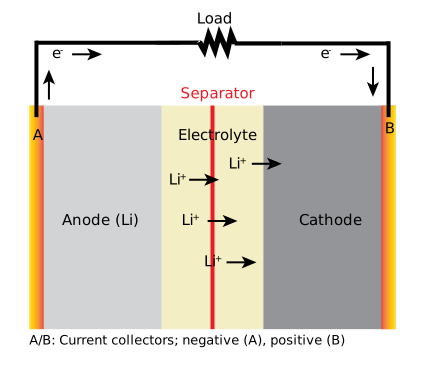
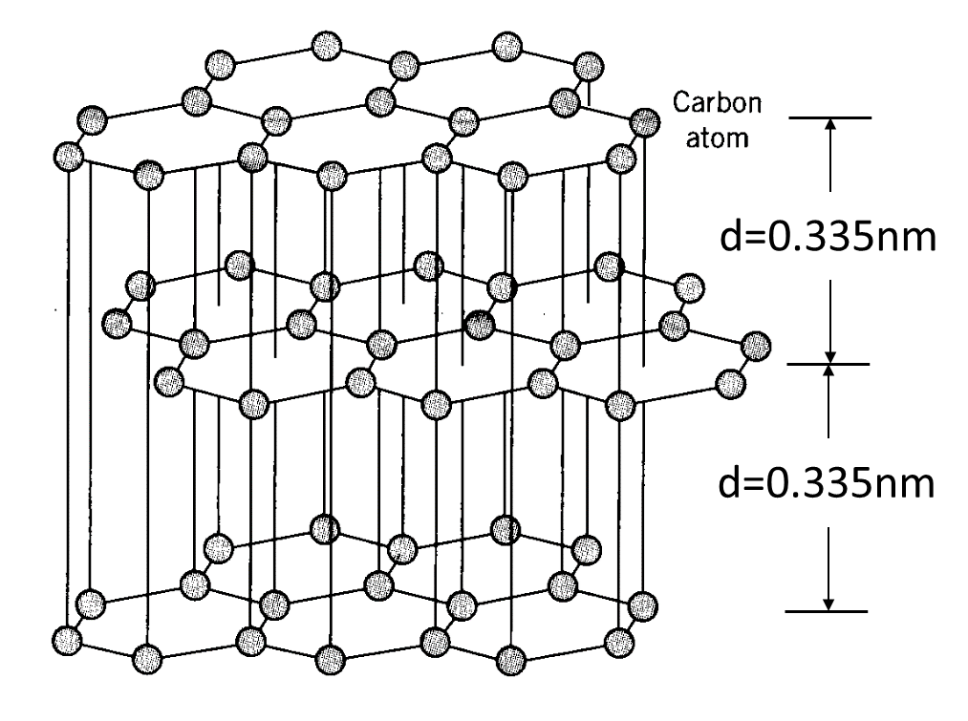
Lithium-ion cells have used a graphite anode since the format's earliest commercial days. Graphite is cheap and stable, and lets lithium ions slide in and out of its layered structure without much fuss. Its problem is capacity: graphite can only host one lithium atom for every six carbon atoms, which caps how much energy you can pack into a given volume of anode.
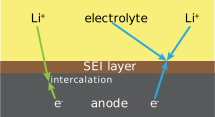
Silicon can do far better. In theory it offers roughly ten times the gravimetric capacity of graphite, because each silicon atom can bond with up to 4.4 lithium atoms. The catch is that silicon swells by up to 300% in volume as it lithiates, and shrinks back down again on the way out. Do that a few hundred times and the material cracks, loses electrical contact, and the cell dies fast.
The compromise that ships
Nobody has solved the swelling problem cleanly enough to ship a pure silicon anode, so what's in your phone is a silicon-carbon composite: a graphite matrix doped with a small percentage of silicon, usually as a nanoscale or silicon-oxide phase, spread through carbon that can absorb some of the expansion and keep the particles electrically connected.
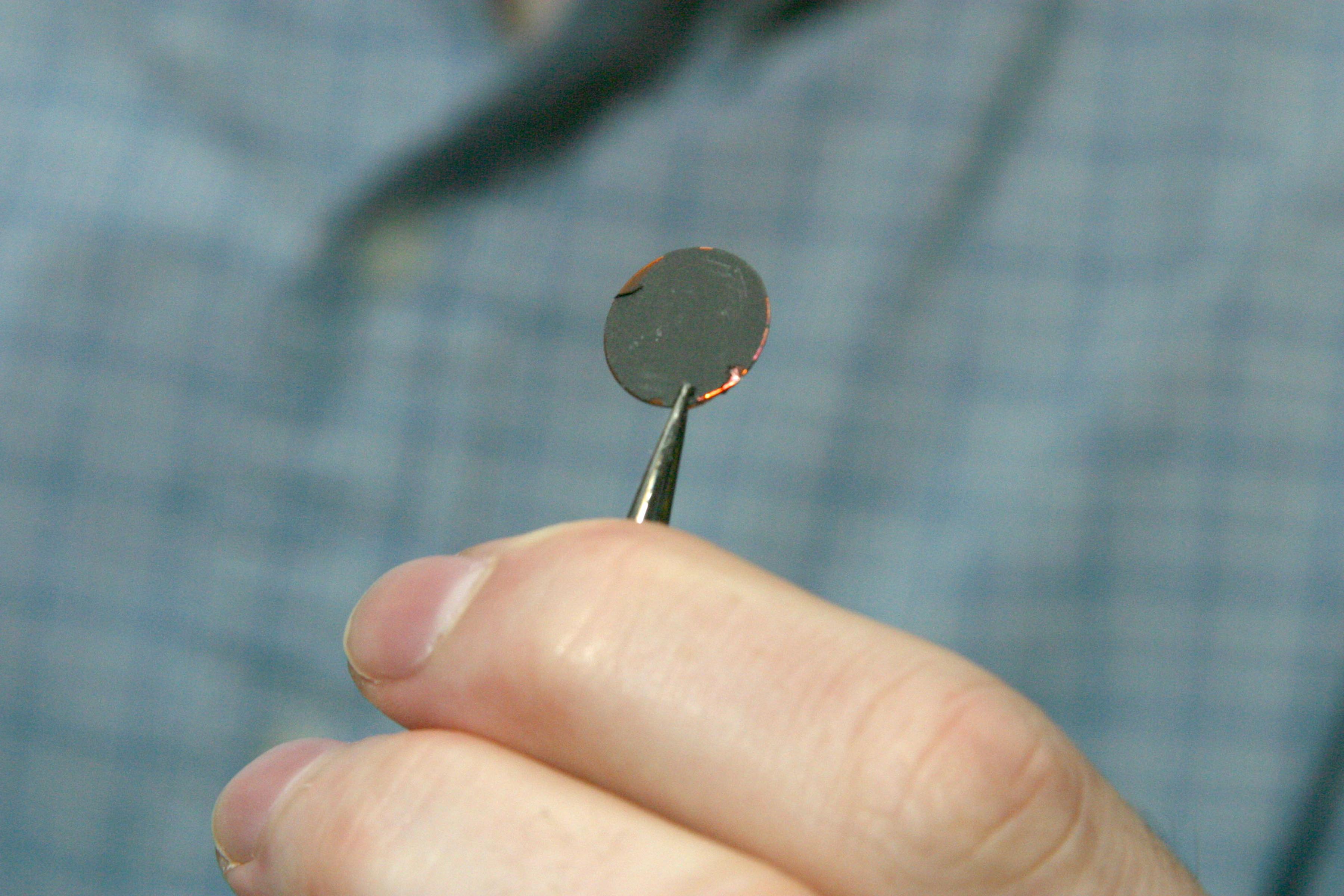
Small silicon percentages go a long way. Even single-digit silicon content in the anode can meaningfully lift a cell's energy density, because it's the anode that was the limiting side of the equation. Reporting on Samsung's latest Galaxy cells points to this kind of blended anode as the source of the claimed capacity gains, alongside the usual stack of cathode and packaging tweaks.
One thing that trips people up: a silicon-carbon anode has nothing to do with silicon carbide. Silicon carbide (SiC) is a wide-bandgap semiconductor for power electronics, the stuff in EV inverters and fast chargers. It lives outside the cell entirely. Similar names, unrelated chemistry.
So why isn't this another Note 7?
The 2016 Note 7 fires traced back to cathode and separator design margins that were too tight for the cell's dimensions, made worse by aggressive fast-charging profiles. Anode chemistry had little to do with it. Silicon-carbon anodes introduce their own failure mode to manage (mechanical degradation from repeated swelling), but it's a well-studied one, and the fix is mostly in how much silicon you add and how well it's buffered by the surrounding carbon.
The practical result is incremental gains, engineered conservatively. Degradation curves get ugly fast past a certain silicon fraction, so nobody is putting 100% silicon in a phone anytime soon. A carefully blended few percent, though, is a shippable way to claw back capacity without changing the size of the can.
The number I'd wait for
Cycle life after a year of real use is the figure that settles this, and it's the one nobody has yet. Swelling-driven degradation accumulates gradually, so a cell that looks fine in month two can look considerably worse in month fourteen. Beyond that I'd watch whether silicon content creeps up in later generations as buffering techniques improve, since carbon coatings and pre-lithiation are both getting better, and whether the same blend shows up in EV packs, where the capacity pressure is higher and there's nowhere to hide a swelling problem.
It's a small win, and it took a lot of materials work to get. Mostly it means your phone lasts a bit longer before the low-battery nag starts.
Further reading
- Obrovac, M.N. & Christensen, L. "Structural Changes in Silicon Anodes during Lithium Insertion/Extraction." Electrochemical and Solid-State Letters, 7(5), A93–A96 (2004). iopscience.iop.org
- Magasinski, A., Dixon, P., Hertzberg, B., Kvit, A., Ayala, J., & Yushin, G. "High-performance lithium-ion anodes using a hierarchical bottom-up approach." Nature Materials, 9, 353–358 (2010). DOI: 10.1038/nmat2725
- Wu, H., Chan, G., Choi, J.W., et al. "Stable cycling of double-walled silicon nanotube battery anodes through solid–electrolyte interphase control." Nature Nanotechnology, 7, 310–315 (2012). DOI: 10.1038/nnano.2012.35
- McDowell, M.T., Lee, S.W., Nix, W.D., & Cui, Y. "25th Anniversary Article: Understanding the Lithiation of Silicon and Other Alloying Anodes for Lithium-Ion Batteries." Advanced Materials, 25(36), 4966–4985 (2013). DOI: 10.1002/adma.201301795
- Asenbauer, J., Eisenmann, T., Kuenzel, M., et al. "The success story of graphite as a lithium-ion anode material." Sustainable Energy & Fuels, 4, 5387–5416 (2020). Open access, CC BY 3.0. DOI: 10.1039/D0SE00175A
- Liu, T., et al. "Issues impeding the commercialization of laboratory innovations for energy-dense Si-containing lithium-ion batteries." Nature Energy, 8, 1329–1343 (2023). nature.com
- "Recent progress and challenges in silicon-based anode materials for lithium-ion batteries." Industrial Chemistry & Materials, 2(2), 226–261 (2024). Open access. DOI: 10.1039/D3IM00115F
- "Innovative Solutions for High-Performance Silicon Anodes in Lithium-Ion Batteries." Nano-Micro Letters, 16, 264 (2024). link.springer.com
- Jin, B., Liao, L., Shen, X., et al. "Advancement in Research on Silicon/Carbon Composite Anode Materials for Lithium-Ion Batteries." Metals, 15(4), 386 (2025). Open access, CC BY. DOI: 10.3390/met15040386
- Lin, S., Yang, M., Zhao, Z., et al. "Super High Capacity of Lithium Battery Silicon-Carbon Anode over 6,500 mAh g⁻¹." Research, 9, 1179 (2026). Open access, CC BY 4.0. DOI: 10.34133/research.1179
- Ryan, J. "The Age of Silicon Is Here…for Batteries." IEEE Spectrum. spectrum.ieee.org
- "Silicon Anode Batteries for EVs Are Ready for Production." IEEE Spectrum (2024). spectrum.ieee.org
- "Silicon-Carbon Batteries Explained." Ossila. ossila.com
- Bomgardner, M.M. "Samsung: Flaws led to Note 7 fires." Chemical & Engineering News, 95(5) (2017). cen.acs.org