 Prakhar Gautam
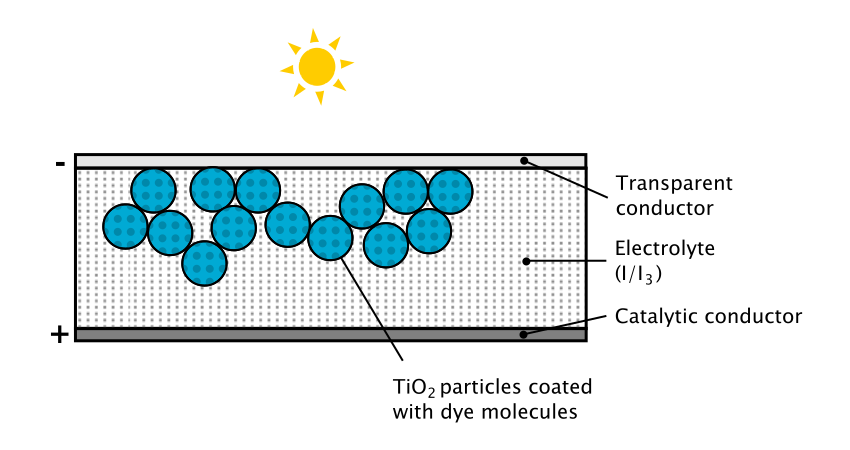
Most solar cells you've heard of are one material doing two jobs: silicon both absorbs the light and moves the resulting charge. Dye-sensitized solar cells (DSSCs) split that job in two, which is closer to how a leaf handles it, and the dye is the part that has to work hardest.
Two materials, two jobs
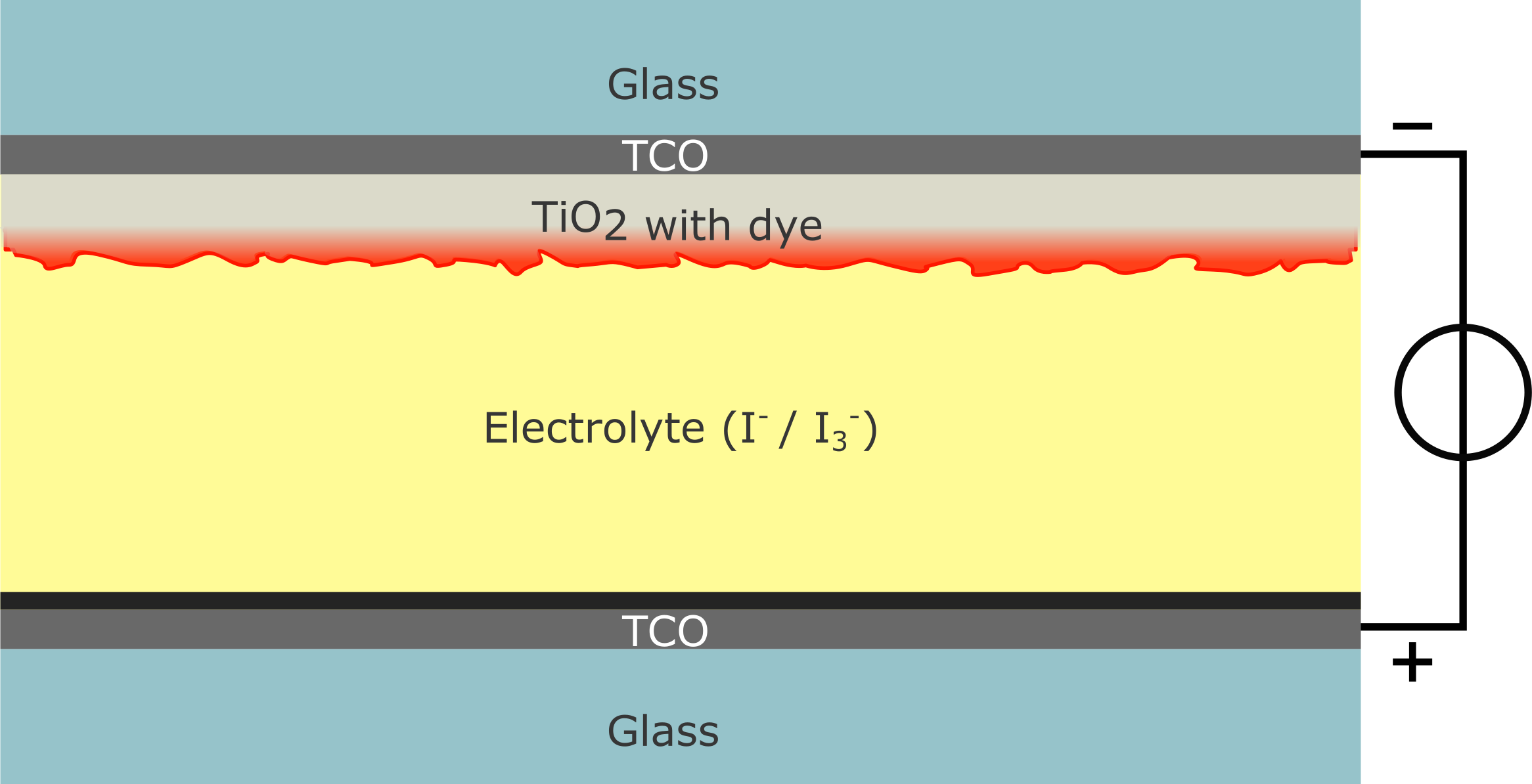
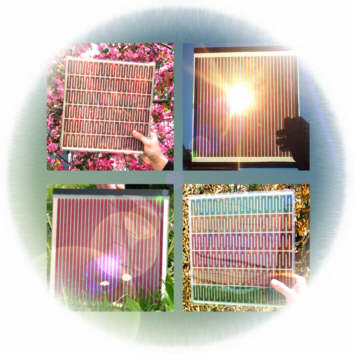
A DSSC is built from a mesoporous layer of titanium dioxide, a wide-bandgap semiconductor that's essentially transparent to visible light on its own, coated in a single molecular layer of dye. The dye absorbs a photon, gets excited, and injects an electron into the TiO2's conduction band. The TiO2 never has to absorb anything; it just has to move the electron along once the dye hands it over. The architecture exists for that division of labor, which is why the dye's chemistry matters so much more here than in a conventional cell.
Why ruthenium
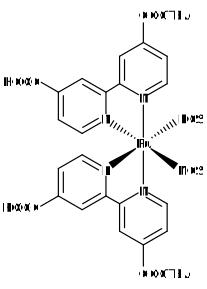
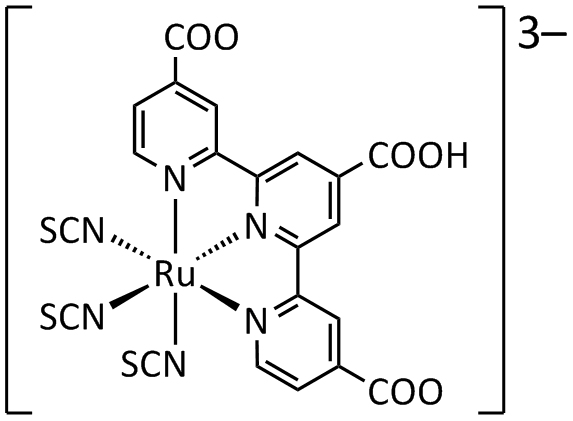
Since Grätzel and O'Regan's original 1991 cell, ruthenium polypyridyl complexes have been the workhorse sensitizers. These are the dyes known in the field as N3, N719, and the "black dye". A ruthenium(II) center sits at the middle of bipyridyl or terpyridyl ligands carrying carboxylic acid groups that anchor the whole complex to the TiO2 surface, while thiocyanate ligands help tune exactly where the absorption bands land. The light absorption itself comes from metal-to-ligand charge transfer, an electron briefly moving from the ruthenium center onto a ligand. That gives these dyes strong absorption across most of the visible spectrum and a redox couple stable enough to survive years of cycling.
Where iridium comes in
Iridium complexes are better known from OLED displays, where the metal's strong spin-orbit coupling lets excited states cross efficiently into long-lived triplet states. This is the "heavy atom effect" that makes iridium phosphors so efficient at turning electricity into light. Run that same property in reverse and iridium complexes become useful DSSC sensitizers too, with the advantage that their absorption bands and energy levels are unusually tunable through ligand design. In practice iridium dyes work best alongside ruthenium: co-sensitizing a cell with both broadens the combined absorption further into the spectrum than either dye manages alone.
The word "dye" is doing some work here. In the traditional sense a dye is an organic pigment; these are coordination complexes, a metal center wrapped in organic ligands and engineered the way you'd engineer any other catalyst. People also file ruthenium and iridium under rare-earths, which they aren't. Both are platinum-group precious metals. They're expensive per gram, but a cell uses so little that the metal cost per device stays manageable.
The catch
That last point only stretches so far. Precious-metal supply is still precious-metal supply, and it's the main reason so much DSSC research has drifted toward metal-free organic dyes and porphyrin-based sensitizers, which are cheaper and easier to scale but have historically lagged on efficiency and long-term stability. Meanwhile perovskite solar cells have taken the headline efficiency numbers that DSSCs used to chase, which has pushed dye-sensitized cells toward a narrower, more specialized niche rather than utility-scale competition.
Open questions
- Whether co-sensitization schemes mixing ruthenium, iridium and organic dyes can keep widening combined spectral coverage, or whether the gains flatten out.
- Whether metal-free and porphyrin dyes close the efficiency gap enough to matter outside a lab bench.
- Indoor and ambient-light photovoltaics, where DSSCs outperform silicon under dim, diffuse light. Powering low-draw IoT sensors is the obvious application and the one I'd bet on.
DSSCs lost the headline efficiency race a decade ago and probably aren't coming back for it. I still think the coordination chemistry underneath them is some of the prettiest work in photovoltaics.
Further reading
- O'Regan, B. & Grätzel, M. "A low-cost, high-efficiency solar cell based on dye-sensitized colloidal TiO2 films." Nature, 353, 737–740 (1991). DOI: 10.1038/353737a0
- Nazeeruddin, M.K. et al. "Conversion of Light to Electricity by cis-X2bis(2,2′-bipyridyl-4,4′-dicarboxylate)ruthenium(II) Charge-Transfer Sensitizers... on Nanocrystalline Titanium Dioxide Electrodes." Journal of the American Chemical Society, 115(14), 6382–6390 (1993). DOI: 10.1021/ja00067a063
- Nazeeruddin, M.K., Zakeeruddin, S.M., Humphry-Baker, R., et al. "Acid–Base Equilibria of (2,2′-Bipyridyl-4,4′-dicarboxylic acid)ruthenium(II) Complexes..." Inorganic Chemistry, 38(26), 6298–6305 (1999). DOI: 10.1021/ic990916a
- Nazeeruddin, M.K., Péchy, P., Renouard, T., et al. "Engineering of Efficient Panchromatic Sensitizers for Nanocrystalline TiO2-Based Solar Cells." Journal of the American Chemical Society, 123(8), 1613–1624 (2001). DOI: 10.1021/ja003299u
- Baranoff, E., Yum, J.-H., Jung, I., et al. "Cyclometallated Iridium Complexes as Sensitizers for Dye-Sensitized Solar Cells." Chemistry – An Asian Journal, 5(3), 496–499 (2010). DOI: 10.1002/asia.200900429
- Mishra, A., Fischer, M.K.R., & Bäuerle, P. "Metal-Free Organic Dyes for Dye-Sensitized Solar Cells." Angewandte Chemie International Edition, 48(14), 2474–2499 (2009). DOI: 10.1002/anie.200804709
- Aghazada, S. & Nazeeruddin, M.K. "Ruthenium Complexes as Sensitizers in Dye-Sensitized Solar Cells." Inorganics, 6(2), 52 (2018). Open access, CC BY 4.0. DOI: 10.3390/inorganics6020052
- Giannouli, M. "Current Status of Emerging PV Technologies: A Comparative Study of Dye-Sensitized, Organic, and Perovskite Solar Cells." International Journal of Photoenergy, 2021, 6692858. DOI: 10.1155/2021/6692858
- D'Amico, F., de Jong, B., Bartolini, M., et al. "Recent Advances in Organic Dyes for Application in Dye-Sensitized Solar Cells under Indoor Lighting Conditions." Materials, 16(23), 7338 (2023). DOI: 10.3390/ma16237338
- Korir, B.K., Kibet, J.K., & Ngari, S.M. "A review on the current status of dye-sensitized solar cells: Toward sustainable energy." Energy Science & Engineering, 12, 3188–3226 (2024). DOI: 10.1002/ese3.1815
- Ren, Y., Zhang, D., Suo, J., et al. "Hydroxamic acid pre-adsorption raises the efficiency of cosensitized solar cells." Nature, 613, 60–65 (2022). DOI: 10.1038/s41586-022-05460-z
- Broadwith, P. "Dyeing for a place in the sun." Chemistry World (2012). chemistryworld.com
- "Dye-sensitized solar cells achieve a new record." ScienceDaily, source: EPFL (2022). sciencedaily.com
- U.S. Geological Survey, National Minerals Information Center. "Platinum-Group Metals Statistics and Information." usgs.gov