 Prakhar Gautam
Grid-scale batteries have a different job than the one in your phone. Nobody cares how much a substation weighs, and nobody's carrying it up a flight of stairs. What the grid needs is hours of storage, cheap enough per kilowatt-hour that it makes sense to buy a lot of it, and durable enough to survive being cycled every single day for a couple of decades. Lithium-ion is good at a lot of things, but it was never built for that particular problem. Vanadium redox flow batteries were.
Splitting energy from power
In a lithium-ion cell, energy and power come from the same piece of hardware. Want more energy storage? You add more cells. Want more power? You also add more cells, or make them bigger. The two are locked together by the physical battery itself.
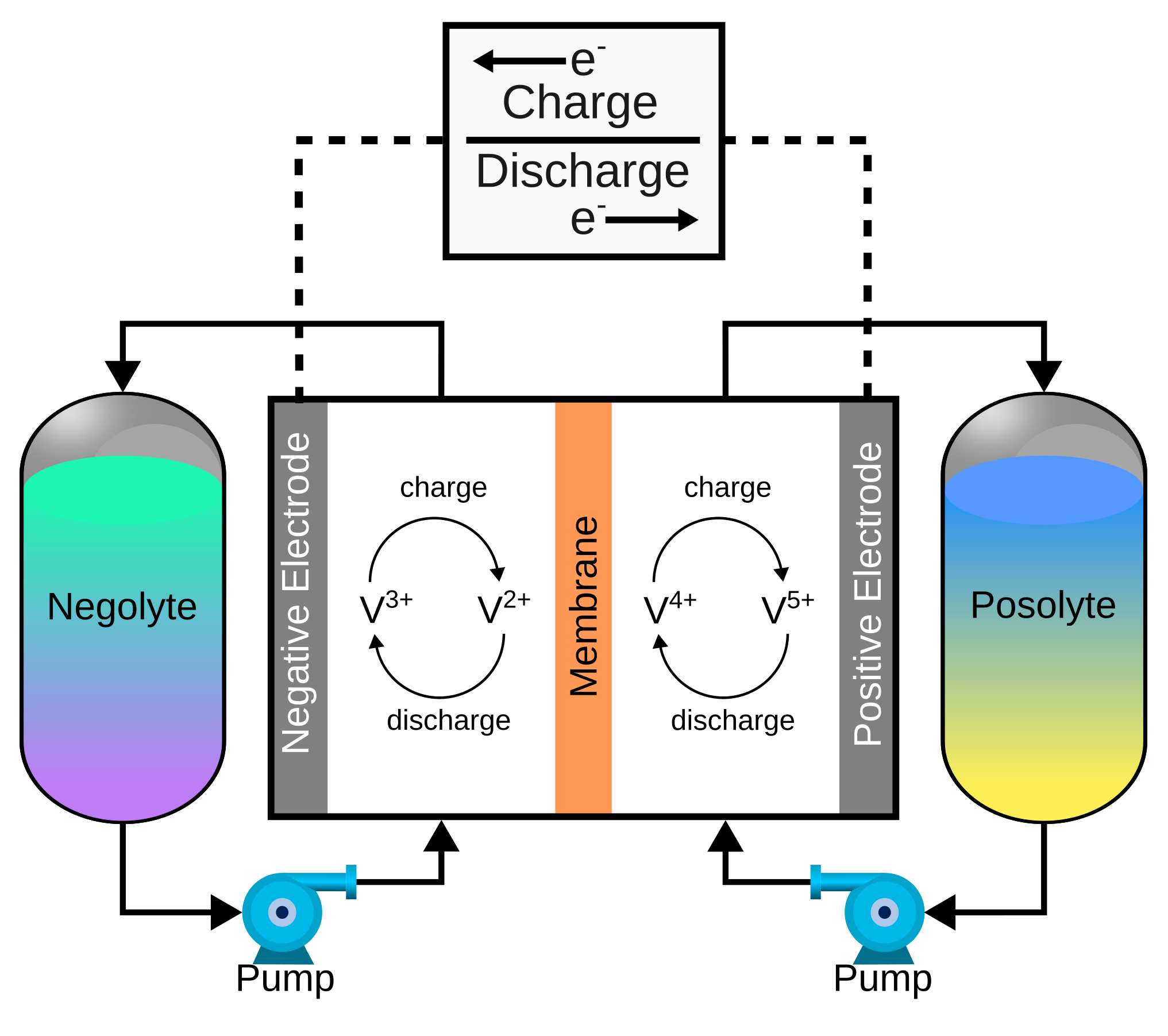
A flow battery breaks that link. The electrochemistry happens in a stack of cells, same as any battery, but the charge carriers don't live in the stack. They're dissolved in liquid electrolyte, sitting in two external tanks. The stack determines how fast you can charge or discharge (power). The tank size determines how long you can do it for (energy). Need more storage duration without more power? Make the tanks bigger and leave the stack alone. That's a much cheaper knob to turn than manufacturing more electrochemical cells.
Why the same element on both sides
Early flow battery chemistries paired two different redox couples, iron and chromium for instance, one in each tank. The problem is that ion-exchange membranes aren't perfect. A little electrolyte always leaks across, and when the two sides are chemically different, that leak is permanent damage: contaminated electrolyte that can't be un-mixed, and capacity that doesn't come back.
The vanadium redox flow battery gets around this by running vanadium, in different oxidation states, on both sides. The negative electrolyte cycles between V³⁺ and V²⁺; the positive electrolyte cycles between VO²⁺ and VO₂⁺. Both tanks are just vanadium in water and sulfuric acid. When electrolyte inevitably crosses the membrane, what ends up on the other side is still vanadium, sitting in the wrong tank. Rebalance the electrolyte occasionally and the capacity comes right back. It's a maintenance step rather than a failure.
The standard cell voltage works out to 1.26 V, which is modest next to a lithium-ion cell. That's fine here, because the system runs as a stack of many cells in series rather than one large one.
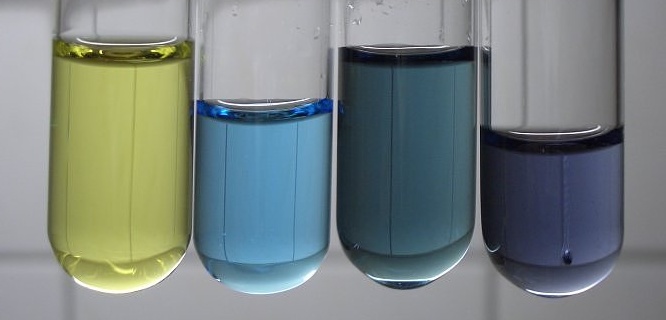
The four vanadium oxidation states involved also happen to be four different colors: V²⁺ is violet, V³⁺ is green, VO²⁺ is blue, and VO₂⁺ is yellow. The color gives you an at-a-glance readout of roughly where the battery sits in its charge cycle, which is more useful on site than it sounds.
The tradeoff that doesn't matter here
Vanadium electrolyte stores a lot less energy per liter than a lithium-ion cell stores per kilogram, by a wide margin. For a car or a phone, that would be disqualifying. For a shipping-container-sized installation sitting next to a substation, it mostly isn't, because there's room for more tanks.
In exchange, VRFBs pick up something lithium-ion structurally can't match: cycle life. A lithium-ion cell degrades because its electrodes physically change shape every cycle, host lattices expanding and contracting as ions intercalate in and out, slowly cracking and losing contact. A VRFB's electrolyte doesn't move or change shape; it only changes oxidation state in solution. With proper electrolyte maintenance, systems are routinely rated past 10,000 cycles, and some testing pushes toward 20,000 before meaningful degradation shows up. You give up energy density and get back a battery that will probably outlast the building it's installed in.
Where these get built
The Dalian Flow Battery Energy Storage Peak-shaving Power Station, in Liaoning, China, is the plainest evidence that this technology has left the lab. Developed from technology out of the Dalian Institute of Chemical Physics and built by Rongke Power, its first phase connected to the grid in 2022 at 100 MW / 400 MWh, or four hours of storage at full output, with a full build-out planned for 200 MW / 800 MWh. It exists to smooth out exactly the problem intermittent solar and wind create: generation that doesn't line up with demand, over a span of hours.
None of this is new. Maria Skyllas-Kazacos and her group at the University of New South Wales built the first working all-vanadium cell in 1985 and filed the founding patent in 1986. It spent decades as a promising-but-niche technology while lithium-ion ran away with every application where energy density mattered. The chemistry hasn't changed since. The grid's storage problem turned out to be a duration problem, and duration is the one thing this 40-year-old battery was always better at.
My own personal ideas and thoughts of the future
The VO²⁺/VO₂⁺ half-reaction at the positive electrode is the sluggish half of a VRFB. It needs an electron and two protons to move at once, so it ends up being the rate-limiting step for the cell. The usual fix is to dope the electrode surface with a catalyst, and the catalysts that work best are expensive and often toxic: platinum, bismuth, iridium. Fine for proving a concept on a benchtop. Much worse if you want to deploy at Dalian's scale.
In 2023 I wrote a research proposal on an alternative to that: molybdenum disulfide (MoS₂), a cheap layered material already known for catalyzing hydrogen evolution, doped with nitrogen, phosphorus, or silicon and grafted onto carbon nanotubes to use as the electrode itself. The idea is that heteroatom doping opens up new electronic states near MoS₂'s Fermi level, nudging it from a mediocre semiconductor toward something closer to a real catalyst, and doing it without a precious metal anywhere in the cell.
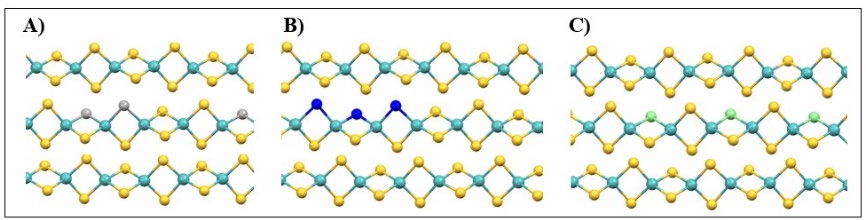
Grafted onto CNTs for conductivity and dropped into a working vanadium cell, the goal was to see whether that doped MoS₂ could measurably speed up the same sluggish cathode reaction that's currently propping up a chunk of the platinum-group-metal supply chain inside these batteries. It's a proposal I wrote for my candidacy exam, not something I pursued in my graduate research.
Other groups have already shown the individual pieces work. Liu et al. grafted MoS₂ nanosheets onto ultralong N-doped carbon nanotubes and confirmed via XRD, SEM, and TEM that the nanosheets form a well-adhered, hierarchical structure on the tubes instead of clumping, which is the morphology an electrode needs if the electrolyte is going to reach the catalytic sites at all. Separately, nitrogen-doping MoS₂ measurably drops its charge-transfer resistance: EIS Nyquist plots comparing pristine MoS₂ against N-MoS₂ show a visibly smaller semicircle for the doped material, meaning electrons move through it more easily. That's precisely the property that would have to improve for a doped-MoS₂ cathode to help.
The closest real-world proof of concept is a MoS₂-modified graphite felt electrode tested directly in a vanadium cell, which beat a standard graphite felt electrode on voltage, coulombic, and energy efficiency, and retained more charge capacity over repeated cycling.
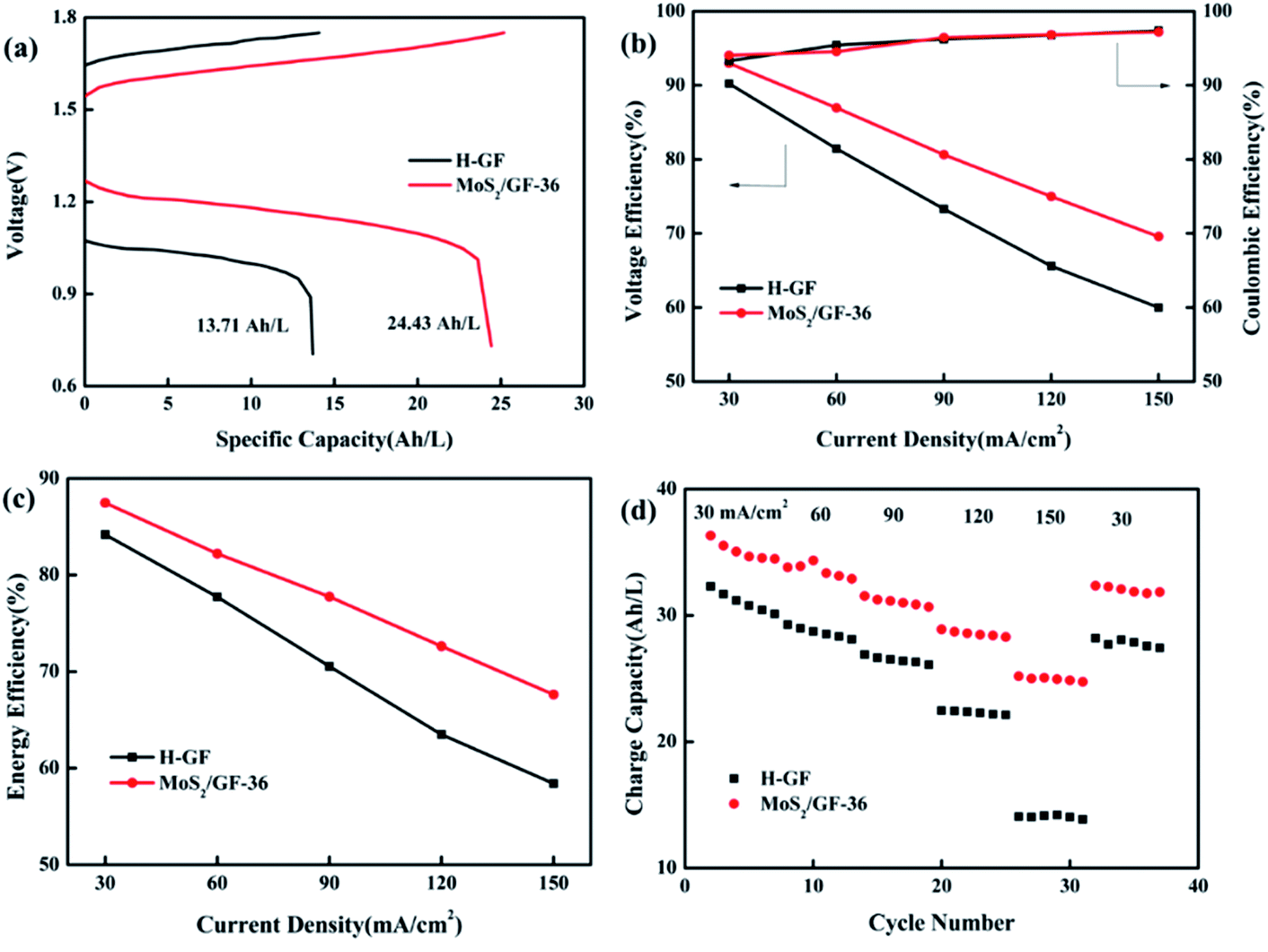
That's graphite felt rather than CNTs, so it's a different electrode material, but it's the same underlying bet: MoS₂ is doing real catalytic work at the cathode of a real cell, well past the point of a DFT simulation. Combine that with the conductivity gains from CNT grafting and the charge-transfer gains from heteroatom doping and you have the sort of unglamorous electrode chemistry that decides whether a technology like this keeps getting cheaper, or stays a promising idea from the 1980s that never quite scaled.
Further reading
- Skyllas-Kazacos, M., et al. "Review—Highlights of UNSW All-Vanadium Redox Battery Development: 1983 to Present." Journal of The Electrochemical Society, 169, 070513 (2022). DOI: 10.1149/1945-7111/ac7bab
- Lourenssen, K., Williams, J., Ahmadpour, F., Clemmer, R., & Tasnim, S. "Vanadium redox flow batteries: A comprehensive review." Journal of Energy Storage, 25, 100844 (2019). DOI: 10.1016/j.est.2019.100844
- Kim, K.J., Park, M.-S., Kim, Y.-J., Kim, J.H., Dou, S.X., & Skyllas-Kazacos, M. "A technology review of electrodes and reaction mechanisms in vanadium redox flow batteries." Journal of Materials Chemistry A, 3(33), 16913–16933 (2015). DOI: 10.1039/C5TA02613J
- Wang, L., Li, S., Li, D., Xiao, Q., & Jing, W. "3D flower-like molybdenum disulfide modified graphite felt as a positive material for vanadium redox flow batteries." RSC Advances, 10(29), 17235–17246 (2020). Open access, CC BY 3.0. DOI: 10.1039/D0RA02541K
- Liu, L., Zhang, S., Yan, F., Li, C., Zhu, C., Zhang, X., & Chen, Y. "Three-Dimensional Hierarchical MoS₂ Nanosheets/Ultralong N-Doped Carbon Nanotubes as High-Performance Electromagnetic Wave Absorbing Material." ACS Applied Materials & Interfaces, 10(16), 14108–14115 (2018). DOI: 10.1021/acsami.8b00709
- Liu, Q., Xia, W., Wu, Z., Huo, J., Liu, D., Wang, Q., & Wang, S. "The origin of the enhanced performance of nitrogen-doped MoS₂ in lithium ion batteries." Nanotechnology, 27(17), 175402 (2016). DOI: 10.1088/0957-4484/27/17/175402
- Gautam, P. "Heteroatom Doped MoS₂ Nanosheets grafted onto CNT as Electrodes for Optimizing Electrochemical Activity in Redox Flow Batteries." Unpublished research proposal, Ren Research Group (2023).
- "China connects world's largest redox flow battery system to grid." pv magazine (2022). pv-magazine.com
- "Vanadium redox battery." Wikipedia. en.wikipedia.org
- Guidehouse Insights. "Vanadium Redox Flow Batteries." White paper prepared for Vanitec. vanitec.org